

BOSHAN, June 4 (Xinhua) -- In early summer, the production workshop of "Heshunlu," a time-honored colored glaze brand in Boshan District of Zibo City, east China's Shandong Province, is already swelteringly hot.
Sun Yunhao and his fellow craftsmen use hollow iron pipes to take molten glass material from a kiln exceeding 1,400 degrees Celsius. They blow, shape, stretch and twist, swiftly forming the material by leveraging its fluidity and ductility.
Boshan District, where Sun Yunhao lives, is celebrated as the birthplace of Chinese colored glaze with a history of colored glaze-making spanning thousands of years. Boshan colored glaze originated in the Western Zhou Dynasty (1046 B.C.-771 B.C.), flourished in the Han (202 B.C.-220 A.D.) and Tang (618-907) dynasties, and reached its peak in the Ming (1368-1644) and Qing (1644-1911) dynasties. After the founding of the People's Republic of China in 1949, Boshan colored glaze entered large-scale production. In 2008, "Boshan Colored Glaze Firing Technique" was inscribed on China's national intangible cultural heritage list.
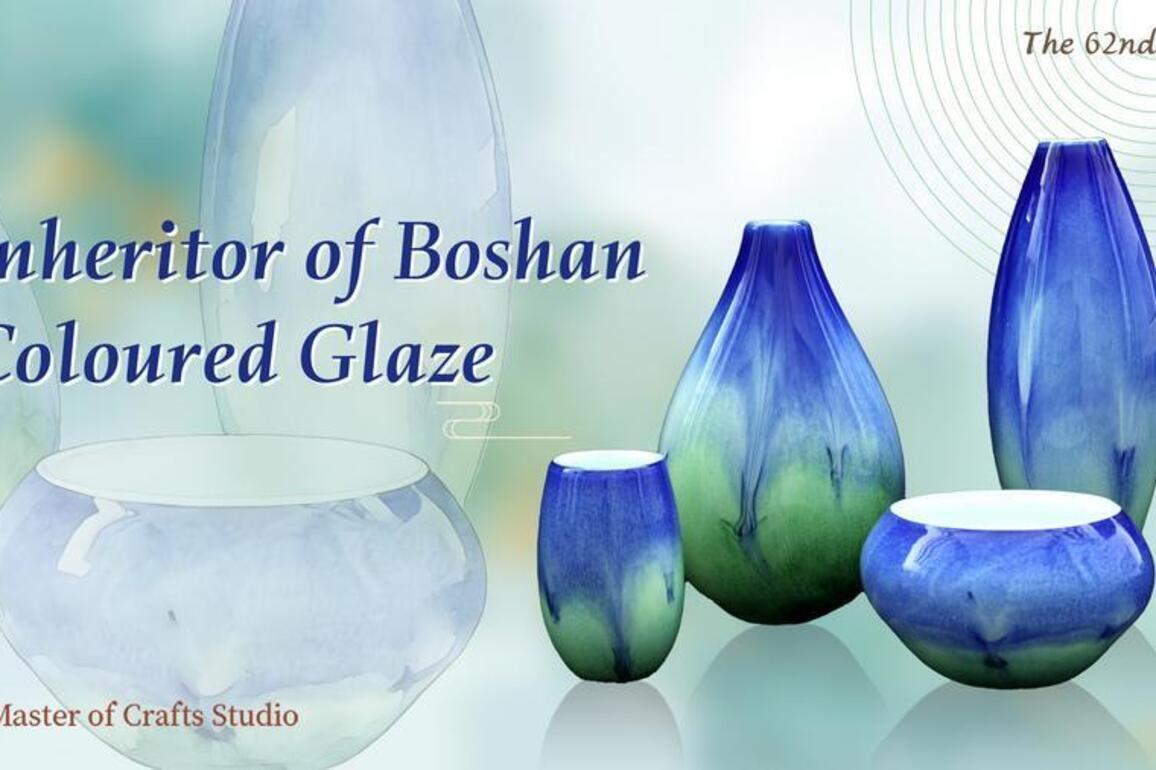
Born in 1977 into a family of colored glaze artisans, Sun Yunhao studied traditional techniques from an early age under his father, Sun Jijie, a master of Chinese colored glaze art. From the proportions of raw materials to the control of firing temperatures, and from vessel design to thermoforming, years of immersion allowed him to elevate the art of "thermoformed colored glaze" to new heights. Through relentless effort, Sun Yunhao's colored glaze works have won several major industry awards.
In March 2025, Sun Yunhao was officially recognized as a national representative inheritor of the "Colored Glaze Firing Technique." Building upon the foundation of traditional craftsmanship, Sun has taken the lead in developing courses on the intangible cultural heritage of colored glaze, introduced western glass-making techniques and spatial concepts, and experimented with cross-disciplinary integration between colored glaze and metal, wood, and ceramics. He has so far cultivated 13 national and provincial masters of arts and crafts and over 30 senior technicians.
Nowadays, there are 13 colored glaze production enterprises and 65 related art studios in Boshan. Over 70 percent of their products are exported to European countries, the United States, etc.